Banks and credit unions · Lakeville

Financial Institution Cleaning in Lakeville

Cleaning for branches where the lobby carries public traffic, conversations behind office doors are confidential, and the crew works inside the access rules your security officer sets.

✓Your security rules govern ✓Lobby and teller line ✓Supervised after-hours entry
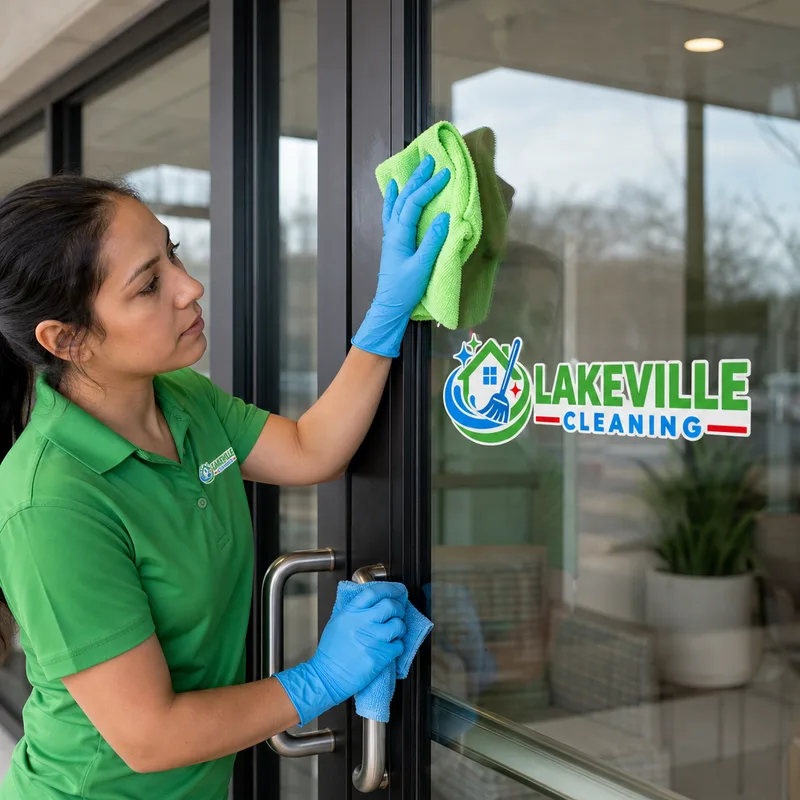
Cleaner removing fingerprints from a glass entry door and adjacent sidelights in a commercial lobby

A branch has public rooms and restricted ones

The public half earns its reputation through small things: a lobby floor without scuff marks, glass doors clear of handprints, writing counters free of smudges, and a restroom that looks maintained rather than merely stocked. Members read all of it as competence.

Behind the teller line the priorities invert. Cash areas, vaults, server closets and records storage are governed by rules that have nothing to do with cleaning, and the crew's job is to work within them: cleared areas only, defined tasks, nothing moved on a desk holding paperwork.

Being a local company operating from 20855 Kensington Blvd, Suite 4 in Lakeville matters more than usual for a branch, because the same small group of cleaners works the building rather than whoever a distant dispatcher sent out that night.

Request a Callback
Branch standards

Cleaning a branch without crossing a boundary

Most of this sector's difficulty is procedural. The cleaning tasks are ordinary; where a crew may go, when, and under whose supervision is the part that needs settling first.

Lobby presentation as the first impression

Entry glass, door hardware, floors, queue areas, writing counters, brochure racks and seating get attention every visit. A member waiting in line has nothing to look at except these surfaces, so smudges register more here than in most workplaces.

Teller line and work surfaces

Counters, dividers, card terminals, pens and the public side of the glass carry constant hand contact. Staff-side surfaces are cleaned around the equipment and the paperwork, never through them, with nothing shifted that somebody left set out.

Offices where conversations happen

Loan and advisory offices hold documents and screens. Crews clean floors, dust what is clear, empty bins and handle touch points, while anything on a desk or a credenza stays exactly as it was found.

Areas cleaning does not enter

Vault interiors, cash handling rooms, server and records space sit outside the scope unless your officer sets a specific supervised arrangement. Naming these in writing protects both sides better than an informal understanding does.

Drive-up lanes and the outside edge

Tube stations, lane glass, the ATM surround and the walk from the parking lot carry the weather in. These exterior-facing points get a defined rotation, since they are also the parts a member touches before anyone greets them.

Access and timing

How branch cleaning gets scheduled around security

Almost every branch decision traces back to access. A main office with staff working late, a small branch inside a retail strip and a drive-up location with limited lobby hours each resolve entry differently, and the answer sets the schedule rather than the other way around. Your security officer leads that conversation and we work to the arrangement they choose.

Access arrangements branches typically pick:

  • ✓Supervised after close. A staff member stays while the crew works, then sets the alarm and locks up. It suits main offices and any branch wanting cleaning in restricted areas, and it fixes the visit to a predictable window.
  • ✓Independent entry under written procedure. Crews hold access under the branch's own protocol, including alarm codes, monitoring notification and a documented escalation contact. This is common once an account has been running and the same cleaners are assigned.
  • ✓Daytime work in public space only. Lobby, restrooms, entries and break areas handled during open hours with staff present throughout. Restricted areas drop out of the scope entirely, which some institutions prefer as a policy matter.

Branch lobbies are hard-surface floors under constant traffic, where finish dulls in the walking lane long before the edges show it. The restorative cycle routine cleaning cannot replace belongs to our floor care service, and a lobby is where that wear shows first.

Request a Callback
Clean open office with arranged desks, vacuumed carpet, and waste bins with fresh liners
Opening an account

From security review to a running branch account

Setting up a branch takes one more step than most buildings do: the access and boundary conversation happens before anybody discusses tasks or frequencies.

01

Meet whoever owns security

Your security officer or branch manager sets out which rooms are available, what supervision is required, how entry works and who gets contacted if an alarm activates. Everything after this is built on those answers.

02

Draw the boundary on paper

Rooms in scope, rooms excluded and rooms needing an escort are listed explicitly. An exclusion written down is a protection for both parties, where an exclusion merely mentioned in conversation tends to get tested at an awkward moment.

03

Assign a consistent crew

The same cleaners hold a branch account, because recognition is part of security in this sector. Changes to who enters the building are communicated in advance rather than discovered by staff or on camera afterward.

04

Check it against the written scope

Visits are reviewed against the document, and your manager raises anything that drifts. Because a branch rarely changes layout, the scope stays stable, and most adjustments involve frequency rather than new tasks.

Request a Callback
Pricing factors

How Much Does Bank Cleaning Cost in Lakeville?

Branch cleaning is typically quoted between about $0.10 and $0.25 per square foot for recurring service. A single branch most often falls in the $300 to $900 per month range, while a larger office with operations space behind the public rooms can reach $1,200 to $6,000+ per month.

Access arrangements affect this as much as area does: supervised entry, restricted rooms left out of scope, and a fixed assigned crew all carry scheduling cost. Lobby glass, teller line surfaces, and restroom count fill in the rest. Everything is settled in writing before a first visit.

Request a Callback
For branch managers

What a branch manager should settle before service begins

Will the same cleaners always service our branch?

That is the intent, and in this sector it matters more than convenience. Staff and cameras should see familiar people, and a consistent crew learns the building's boundaries rather than relearning them. When coverage is needed for an absence, the branch is told who is coming beforehand instead of finding out afterward.

Who holds keys and alarm codes?

Whatever your policy allows. Some institutions issue access to an assigned crew under a written procedure with monitoring notification; others require a staff member present for every visit and issue nothing. Both work. The arrangement gets documented before the first visit, including who is called if an alarm activates.

Do crews clean inside the vault or cash handling areas?

Not unless your officer sets up a specific supervised arrangement, and many branches choose to keep those rooms out entirely. The default is that they sit outside the scope and are listed as exclusions, so there is no ambiguity about where cleaning goes and no awkward judgment call at the door.

How do you handle paperwork left on desks?

It is not touched or moved. Crews clean floors, bins, touch points and whatever surface is clear, and a desk holding documents is cleaned around rather than cleared off. If a branch wants desks done properly, the usual answer is a rule that staff clear them on nights when the crew is scheduled.

Can you service several branches on one agreement?

Yes, and it tends to work better than separate arrangements. One scope covering multiple locations keeps standards and reporting consistent, while each building still gets its own task list, frequency and access procedure, since a drive-up branch and a main office rarely need the same thing.

What about shredding and confidential waste?

That stays with the institution. Crews empty ordinary trash and recycling, and confidential material belongs in your secure containers handled by your own vendor. Mixing the two would put document destruction in the hands of people outside your chain of custody, which no institution should want.

Arrange a review

Set up branch cleaning on your access terms

Let us know how many locations you run, your lobby hours, and whether supervision is required for entry. The walkthrough covers security first and tasks second, and you get the boundary in writing. Contact us and we will set it up with your officer.

Request a quote

Tell us about your space

Send the basics and we will follow up to arrange a walkthrough and put the scope in writing.